Has the message of the Blessed Mother in her manifestation as Our Lady of Guadalupe 494 years ago been lost? Deemed inconsequential, irrelevant, misguided or out-of-date? On a hill near present-day Mexico City, the Blessed Mother brought a message of love, protection, comfort, unity and faith. She delivered it to Juan Diego, a humble 57-year-old laborer. A middle-aged convert to Roman Catholicism, he was reportedly among the first indigenous peoples of Mexico to be baptized into Christianity.
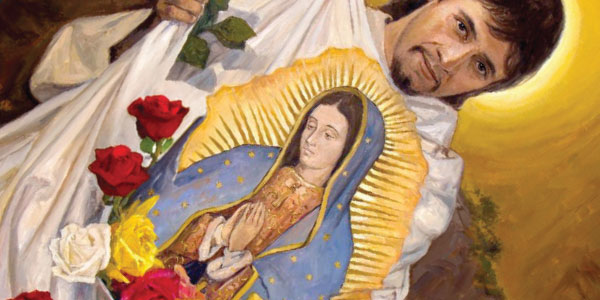
Between Dec. 9 and Dec. 12, 1531, the Blessed Mother appeared to Juan Diego four times. She requested that a shrine in her honor be built on the site of the apparitions, Tepeyac Hill. And when Juan Diego took her request to the bishop, he asked for a sign. Our Lady provided it, according to Catholic tradition. Juan Diego found the hill miraculously abloom with roses despite the killing winter cold. He filled his cloak with fresh roses and took them to the bishop. When he loosened his cloak to release the blossoms, indelibly adorning the lining was a heavenly image of the Blessed Mother. She was pictured with native complexion and features and attired in native dress.
Mexicans, North and South Americans, Roman Catholics and others worldwide venerate Our Lady of Guadalupe. Millions of the faithful visit the shrine to her, the impressive Basilica of Our Lady of Guadalupe on the site of her apparitions; it’s one of the world’s most visited Roman Catholic pilgrimage sites. Next Friday, Dec. 12 is the Feast of Our Lady of Guadalupe.
She’s universally recognized as “the patroness of the Americas, the only manifestation of the Blessed Mother to reign over two continents.” The Brown Virgin, the Mestiza Madonna also serves as an iconic symbol of Mexican culture, history, national identity and religion. Where in her global veneration on the Feast of Our Lady of Guadalupe will be manifest her long-ago message to Juan Diego of love, protection, comfort, unity and faith?
El magnífico mensaje de la Virgen mestiza
¿Se ha perdido el mensaje de la Santísima Madre en su manifestación como la Virgen de Guadalupe hace 494 años? ¿Se ha considerado intrascendente, irrelevante, erróneo o anticuado? En un cerro cerca de la actual Ciudad de México, la Santísima Madre trajo un mensaje de amor, protección, consuelo, unidad y fe. Se lo entregó a Juan Diego, un humilde trabajador de 57 años. Converso al catolicismo romano de mediana edad, se dice que fue uno de los primeros indígenas de México en ser bautizado al cristianismo.
Entre el 9 y el 12 de diciembre de 1531, la Santísima Madre se apareció a Juan Diego en cuatro ocasiones. Solicitó la construcción de un santuario en su honor en el lugar de las apariciones, el cerro del Tepeyac. Y cuando Juan Diego presentó su petición al obispo, este le pidió una señal. La Virgen se la dio, según la tradición católica. Juan Diego encontró el cerro milagrosamente repleto de rosas a pesar del frío invernal. Llenó su manto de rosas frescas y se las llevó al obispo. Al desatar su manto para liberar las flores, una imagen celestial de la Santísima Madre adornaba indeleblemente el forro. Se la representaba con tez y rasgos indígenas, ataviada con trajes típicos.
Mexicanos, norteamericanos y sudamericanos, católicos romanos y otras personas de todo el mundo veneran a la Virgen de Guadalupe. Millones de fieles visitan su santuario, la impresionante Basílica de Santa María de Guadalupe, en el lugar de sus apariciones; es uno de los lugares de peregrinación católica más visitados del mundo. El próximo viernes 12 de diciembre se celebra la festividad de la Virgen de Guadalupe.
Es universalmente reconocida como “la patrona de las Américas, la única manifestación de la Santísima Madre que reina sobre dos continentes”. La Virgen Morena, la Madonna Mestiza, también es un símbolo icónico de la cultura, historia, identidad nacional y religión mexicanas. ¿Dónde, en su veneración global en la festividad de la Virgen de Guadalupe, se manifestará su antiguo mensaje a Juan Diego de amor, protección, consuelo, unidad y fe?