By Tere Siqueira
For years, Luis E. Merlo and Hector Trinidad Perez Sevilla passed the same long wall on Southwest Boulevard almost every day.
Now, their artwork is on it.
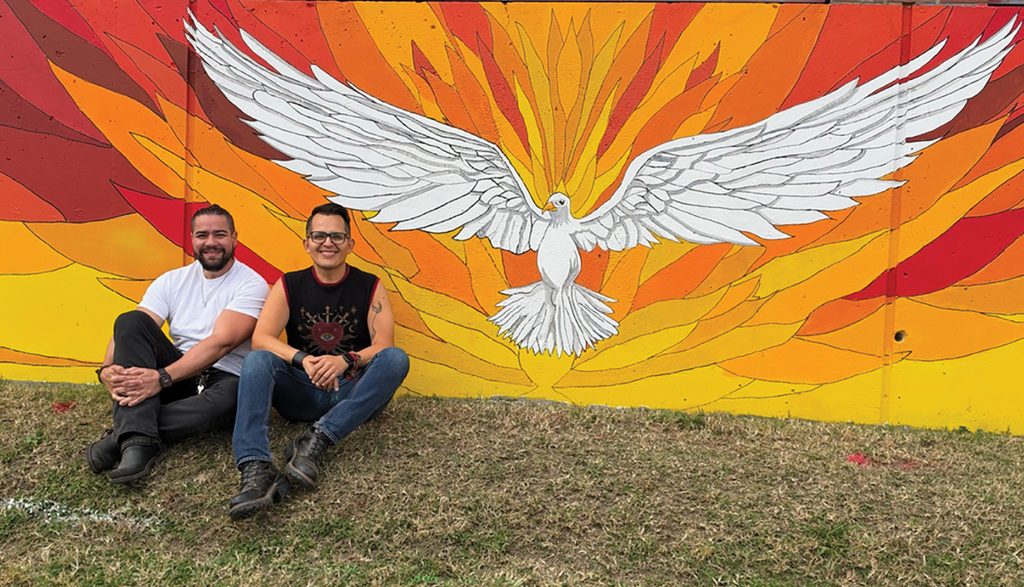
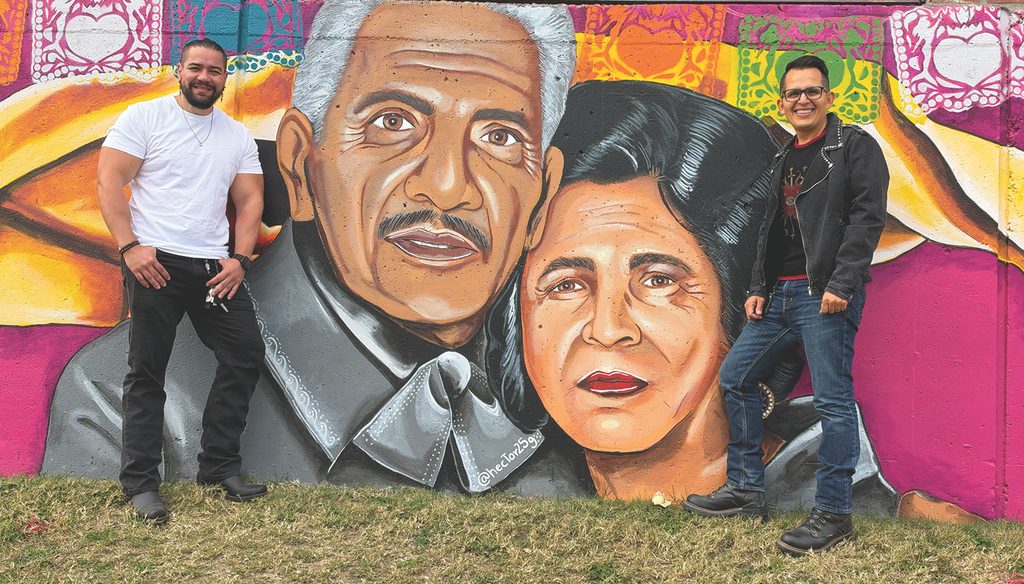
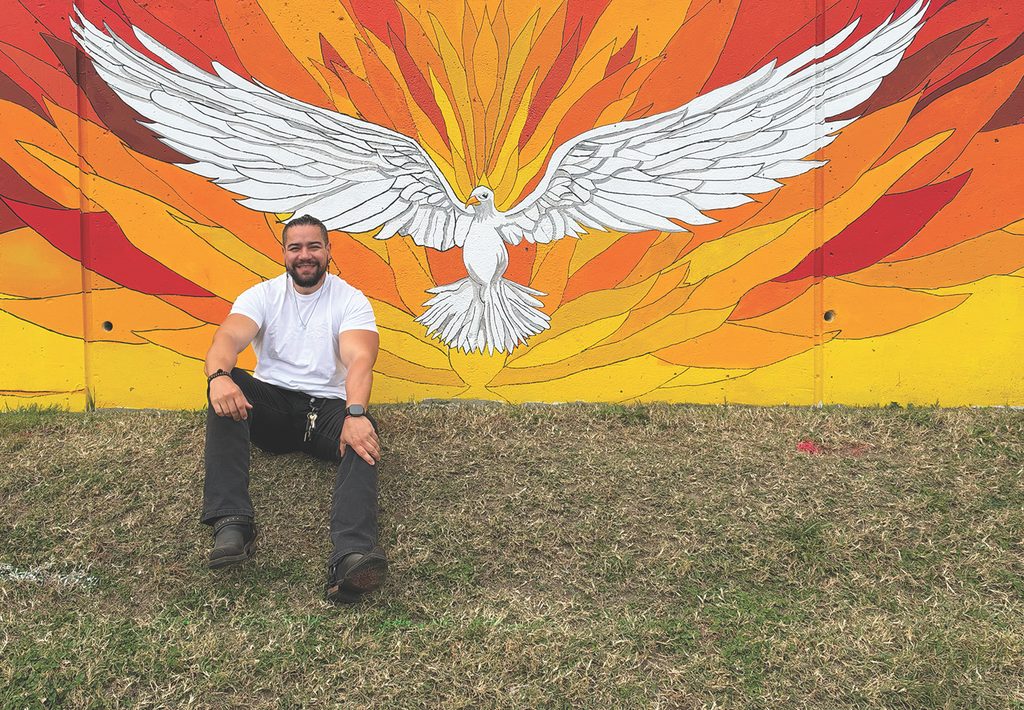
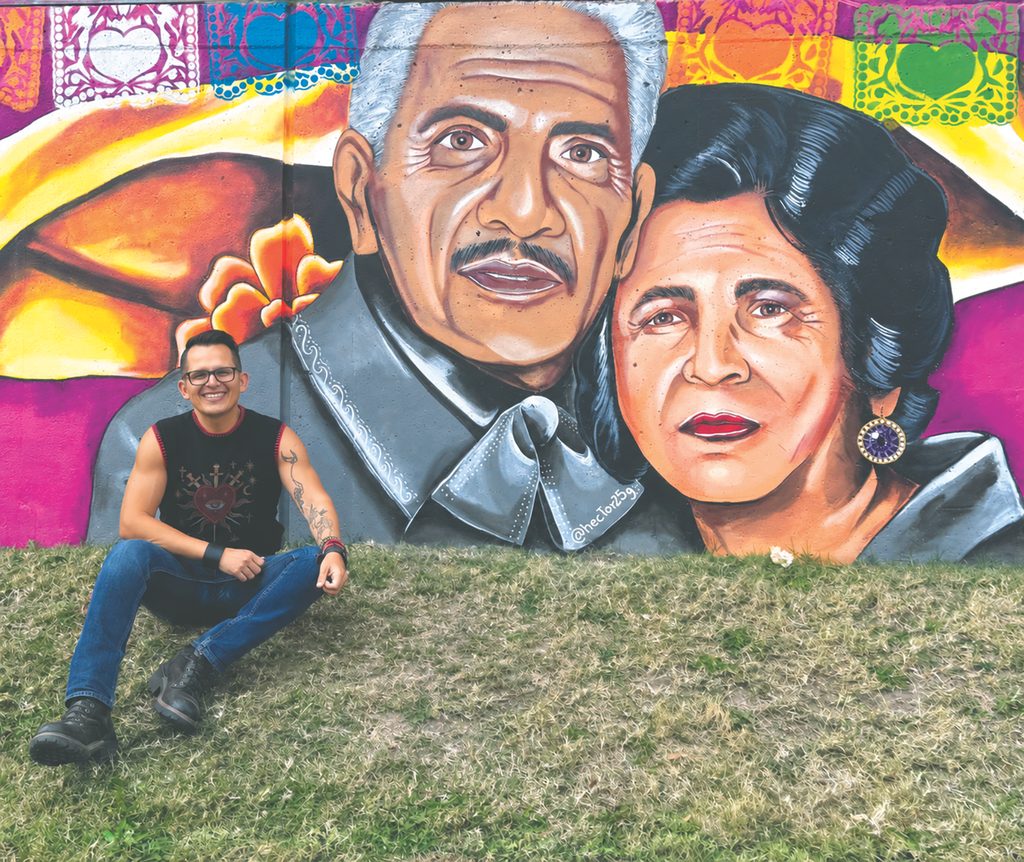
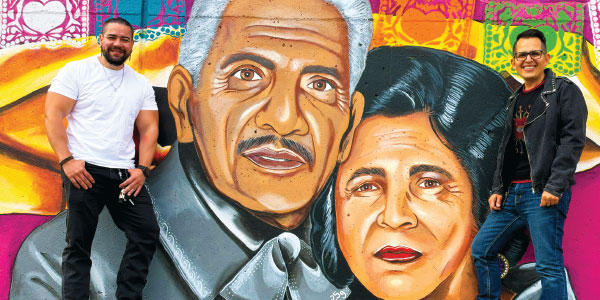
Merlo painted a sun at the center of a mural that’s nearly completed. Perez painted his own grandparents.
Merlo chose the sun for strength, life and hope, he said. Perez said he chose his grandparents to honor those who had come before.
Merlo and Perez, both Dos Mundos employees for 20-plus years, are two of eight Greater Kansas City area artists painting the 683-foot mural. The other artists are Liz Gonzalez, who’s also serving as project coordinator; PK Mitchell; Tyson Johnson; GEAR; Maggie Demeelmeister; and Daniel Herredia. Teens from the Mattie Rhodes Center’s art programs are working alongside them as assistants.
The project is led by Mattie Rhodes, with support from the Jackson County (Missouri) Legislature.
This is the third mural on the wall. Young artists first painted it 35 years ago as part of a project led by Jenny Mendez, now Mattie Rhodes’ arts director, when she was 23. It was refreshed about 15 years ago.
For Perez, who has painted since childhood, working on the latest mural fulfilled an old wish. He had long seen the murals along the boulevard and wanted to take part, but didn’t know how.
“We didn’t have much experience with murals,” he said.
The call to participate came as a surprise to both men. They thought they would be painting the front of the old Dos Mundos building in Kansas City, Missouri, they recalled.
Perez got another surprise when the work got underway.
“It wasn’t until the first day I started painting that I realized the size of the project and everything it involved, because it’s in a Latino neighborhood,” he said. “I felt proud, honored and very happy to have been taken into account, and to return to what we love, which is art.”
Perez and Merlo had another reaction, according Merlo.
“At first, it made us sad to cover the one that was there before,” he said.
The decision was made to cover the older mural because the paint was peeling.
Before painting over the old mural began, the eight artists met around a table and agreed on the themes for the new one: community, family, love, ancestors, migration, culture, faith and peace. Each artist chose what to paint.
GEAR, a muralist who works with Mattie Rhodes, measured the wall and divided it into blocks, Perez recalled. The artists then divided the blocks among themselves according to their ideas. Perez was first assigned the last block, but his colorful style fit better elsewhere, so he traded places with another artist, he said.
“There was zero envy and zero showing off,” Perez said. “Everyone was in the best disposition. The point was to add.”
Merlo got the center section because GEAR told him the sun should go in the middle and the other artists could “adapt to it,” he said. He was a bit intimidated at first.
“It filled me with excitement and pride, but also a little fear, because of the responsibility,” he said, adding that the other artists fit their images around his after asking him what he planned to paint.
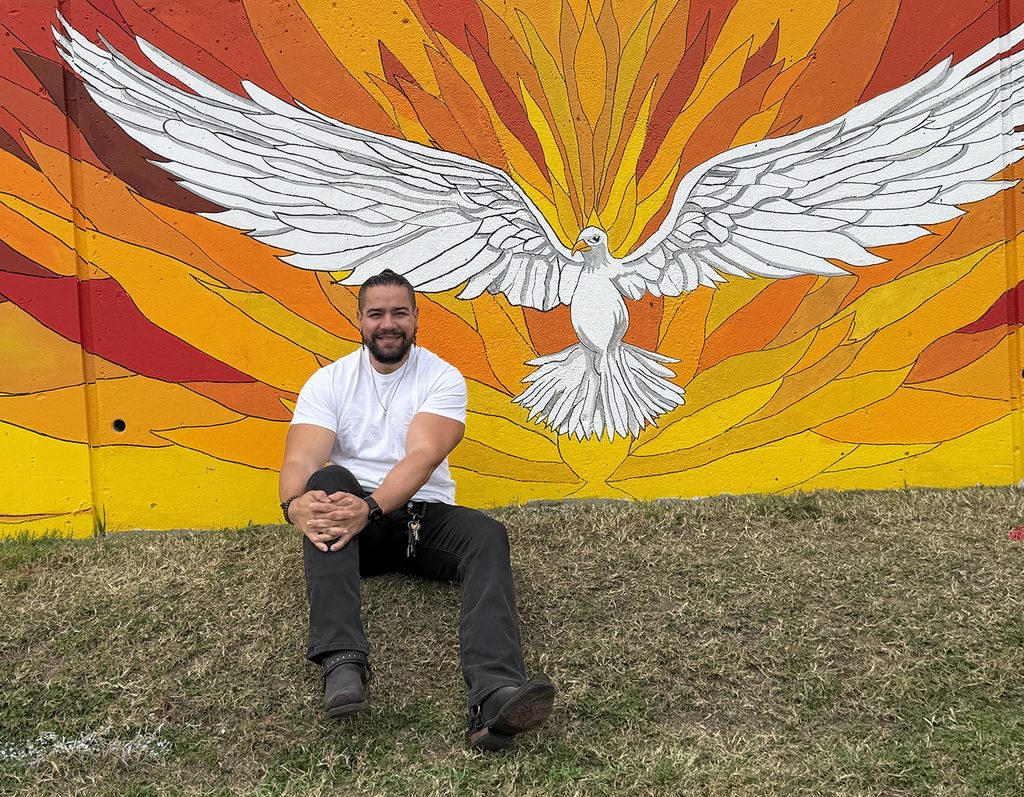
Merlo chose the sun, he said, because “it has always been used by all cultures to represent strength, life, energy, hope.” Specifically, he painted it as an Aztec sun, with a white dove at its center to symbolize peace, faith and hope, he said.
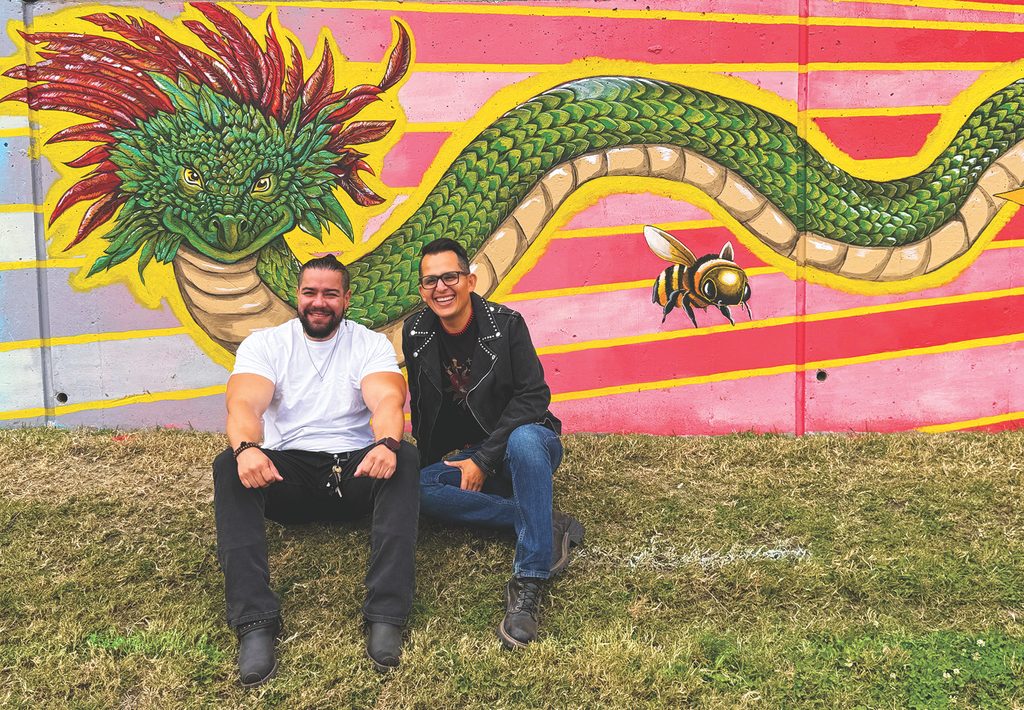
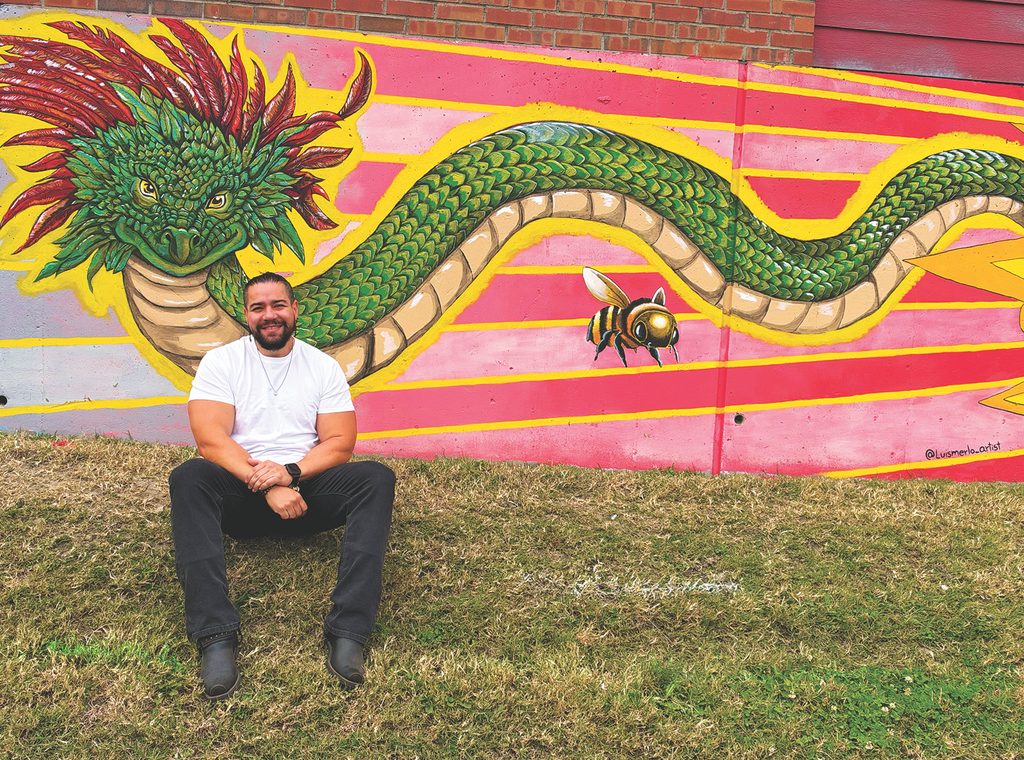
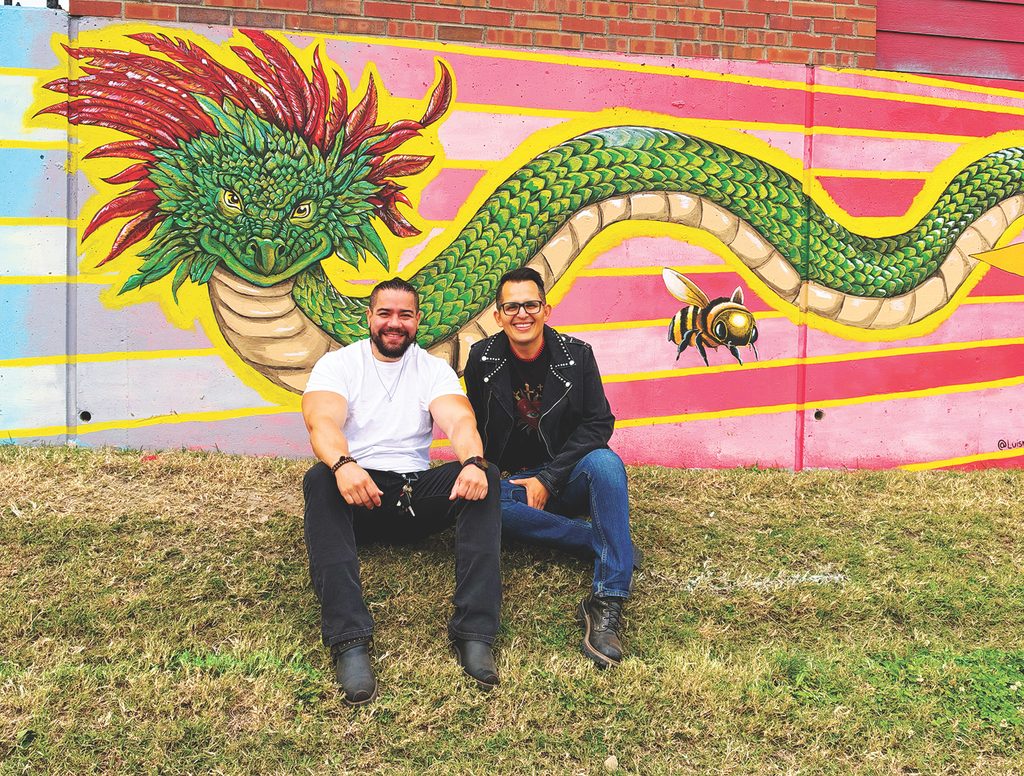
In addition, Merlo added the Aztec deity Quetzalcoatl to represent life, culture and history. He added bees to represent life, hope, work and community, he said.
“I wanted to represent community somehow, but without painting people,” Merlo said.
Merlo used what he considered bright, strong colors for his section, in keeping with what he considers his artistic style. Using bright colors “gives something like life,” he said.
In Perez’s section, his grandparents sit at the center.
“They represent everyone who arrived before us, our grandparents, our great-grandparents,” he said.
Initially, Perez considered painting a couple of unrelated grandparents. Then, he decided they should be his own, he said.
“I put them there because of what they left behind,” Perez said. “Many people have not been able to go back to see their parents, their grandparents, their family.”
Perez painted his grandparents to represent “the ones who had a hard time, the ones who put up with racism, with so many things,” he said.
Perez’s grandparents sold candy in Guadalajara, Jalisco, Mexico, and raised 13 children. He was about 12 when they died, he recalled.
“I only have good memories of them,” Perez said. “I remember their jokes, their affection, their love, their candy.”
One part of the portrait Perez left unfinished on purpose: his grandparents’ eyes and mouths. Four of his grandparents’ children live in the area, including his mother, and he wanted them to finish the portrait of their own parents, he said.
To give them that opportunity, Perez covered his section with a sheet and told his family members he had something to show them. When he pulled the sheet away, they found their mother and father on the wall, their faces still waiting to be completed. He asked each of them to paint a part.
“Nobody knew,” he said. “I gave them the surprise.”
At first, Perez planned to invite only the four children of his grandparents, he said. But when he saw everyone was so excited, he realized the whole family could take part.
“We all come from there,” he told them. “We’re all part of that legacy.”
Two weeks after the unveiling, relatives were still stopping by to paint a small piece of their grandparents’ portrait, Perez recalled. For some of his aunts, he said, the moment was especially strong, because they hadn’t been able to see their parents again before they died.
There are two hearts in Perez’s section, too. Each artist was asked to paint a version of a heart, he said.
One of Perez’s hearts represents those who have died. The other is for music.
“It’s what helps me get through everything,” he said.
People are already commenting on Perez’s section. Some people online have started calling it “The Grandparents’ Mural.” And one woman stopped to talk to him at the wall. She said she had seen it online and it had made her cry, he said.
The woman asked who had painted it. He told her he had. She asked who the people were. He told her they were his grandparents. She told him Perez it was beautiful and he had no idea how helpful it was to the Hispanic community. She also told him she sees Perez’s grandparents when she passes it every day, he said.
“That was the intention,” Perez said.
Merlo also has received feedback – in his case, about the mural in general.
“It’s been gratifying to see how everyone who passes greets us, honks,” Merlo said. “People get out. They tell us, ‘What good work, how beautiful.’ It’s been a lot of demonstrations of affection, respect and admiration.”
Creating the near-finished popular mural hasn’t been easy, Merlo acknowledged. Rain loosened the tape he had put up for his section. When it came off, “it undid a lot of work I’d already done,” Merlo said.
Merlo repainted his section with help from Perez and Gonzalez.
“We gave each other support among all of us – like a community,” Merlo said.
For Merlo and Perez, the wall joins two parts of their lives. Merlo said he and Perez worked a few blocks away from it for years and passed it almost every day.
“It’s really exciting to be part of that place again – where the whole Latino community is,” Merlo said.
For Perez, contributing to the mural also has made him feel part of something larger.
“It makes me feel part of the community,” he said. “I feel I’m in the same group of artists.”
“A part of our history is there now,” Perez added.
To share their history, Perez, Merlo and the other artists painted up to 12 hours a day at the beginning to take advantage of the longer daylight hours. They had hoped to finish before Halloween, when colder weather typically arrives.
The mural still needs a sealant. A date for its official unveiling has yet to be determined.
Perez and Merlo expressed their gratitude to Jenny Mendez; to Diana Reyes Raymer, of Reyes Media Group—publisher of Dos Mundos—and to John Fierro, CEO of Mattie Rhodes, for supporting them in this project, they said.
Hector Perez’s social media handle is @hector25g, and Luis Merlo’s is @luismerlo_artist.
Empleados de Dos Mundos plasman familia, herencia y esperanza en un mural
Durante años, Luis E. Merlo y Hector Trinidad Perez Sevilla pasaron casi todos los días frente al mismo muro largo de Southwest Boulevard.
Ahora, su arte está en él.
Merlo pintó un sol en el centro de un mural que está terminado. Perez pintó a sus propios abuelos.
Merlo eligió el sol por la fuerza, la vida y la esperanza, dijo. Perez contó que escogió a sus abuelos para honrar a quienes llegaron antes.
Merlo y Perez, ambos empleados de Dos Mundos desde hace más de 20 años, son dos de los ocho artistas del área metropolitana de Kansas City que pintan el mural de 683 pies. Los otros artistas son Liz Gonzalez, quien también es coordinadora del proyecto; PK Mitchell; Tyson Johnson; GEAR; Maggie Demeelmeister y Daniel Herredia. Adolescentes de los programas de arte del Mattie Rhodes Center trabajan junto a ellos como asistentes.
El proyecto lo encabeza Mattie Rhodes, con el apoyo de la Legislatura del condado de Jackson (Missouri).
Este es el tercer mural en ese muro. Artistas jóvenes lo pintaron por primera vez hace 35 años, en un proyecto encabezado por Jenny Mendez, hoy directora de artes de Mattie Rhodes, cuando ella tenía 23 años. Se retocó hace unos 15 años.
Para Perez, quien pinta desde niño, trabajar en el mural más reciente cumplió un viejo deseo. Desde hacía tiempo veía los murales a lo largo del bulevar y quería participar, pero no sabía cómo.
“No teníamos mucha experiencia con murales”, dijo.
La invitación a participar los tomó por sorpresa a ambos. Pensaban que pintarían el frente del antiguo edificio de Dos Mundos en Kansas City, Missouri, recordaron.
Perez se llevó otra sorpresa cuando empezó el trabajo.
“No fue hasta el primer día que empecé a pintar que me di cuenta del tamaño del proyecto y de todo lo que implicaba, porque está en un barrio latino”, dijo. “Me sentí orgulloso, honrado y muy contento de que me hayan tomado en cuenta, y de volver a lo que amamos, que es el arte”.
Perez y Merlo tuvieron otra reacción, según Merlo.
“Al principio nos dio tristeza tapar el que estaba antes”, dijo.
Se decidió cubrir el mural anterior porque la pintura se estaba descascarando.
Antes de empezar a pintar sobre el mural viejo, los ocho artistas se reunieron alrededor de una mesa y acordaron los temas del nuevo: comunidad, familia, amor, ancestros, migración, cultura, fe y paz. Cada artista eligió qué pintar.
GEAR, quien es muralista y trabaja con Mattie Rhodes, midió el muro y lo dividió en bloques, recordó Perez. Luego, los artistas se repartieron los bloques según sus ideas. A Perez primero le asignaron el último bloque, pero su estilo colorido encajaba mejor en otro lugar, así que cambió de lugar con otro artista, contó.
“No hubo envidias ni nadie quería lucirse”, dijo Perez. “Todos estaban con la mejor disposición. La idea era sumar”.
A Merlo le tocó la sección central porque GEAR le dijo que el sol debía ir en medio y que los demás artistas podían “adaptarse a él”, contó. Al principio se sintió un poco intimidado.
“Me llenó de emoción y orgullo, pero también de un poco de miedo, por la responsabilidad”, dijo, y agregó que los otros artistas acomodaron sus imágenes alrededor de la suya después de preguntarle qué planeaba pintar.
Merlo eligió el sol, dijo, porque “todas las culturas lo han usado siempre para representar fuerza, vida, energía, esperanza”. En concreto, lo pintó como un sol azteca, con una paloma blanca en el centro que simboliza la paz, la fe y la esperanza, contó.
Además, Merlo agregó a la deidad azteca Quetzalcóatl para representar la vida, la cultura y la historia. También pintó abejas para representar la vida, la esperanza, el trabajo y la comunidad, dijo.
“Quería representar a la comunidad de alguna manera, pero sin pintar personas”, dijo Merlo.
Merlo usó lo que considera colores brillantes y fuertes en su sección, acorde con lo que considera su estilo artístico. Usar colores brillantes “le da algo así como vida”, dijo.
En la sección de Perez, sus abuelos están sentados en el centro.
“Representan a todos los que llegaron antes que nosotros, nuestros abuelos, nuestros bisabuelos”, dijo.
Al principio, Perez pensó en pintar a una pareja de abuelos sin relación con él. Luego decidió que debían ser los suyos, contó.
“Los puse ahí por lo que dejaron atrás”, dijo Perez. “Mucha gente no ha podido regresar a ver a sus papás, a sus abuelos, a su familia”.
Perez pintó a sus abuelos para representar a “los que la pasaron difícil, los que aguantaron el racismo, tantas cosas”, dijo.
Los abuelos de Perez vendían dulces en Guadalajara, Jalisco, México, y criaron a 13 hijos. Él tenía unos 12 años cuando murieron, recordó.
“Solo tengo buenos recuerdos de ellos”, dijo Perez. “Recuerdo sus chistes, su cariño, su amor, sus dulces”.
Una parte del retrato Perez la dejó sin terminar a propósito: los ojos y las bocas de sus abuelos. Cuatro de los hijos de sus abuelos viven en el área, entre ellos su mamá, y quería que ellos terminaran el retrato de sus propios padres, contó.
Para darles esa oportunidad, Perez cubrió su sección con una sábana y les dijo a sus familiares que tenía algo que mostrarles. Cuando quitó la sábana, encontraron en el muro a su madre y a su padre, con los rostros aún sin terminar. Le pidió a cada uno que pintara una parte.
“Nadie sabía”, dijo. “Les di la sorpresa”.
Al principio, Perez planeaba invitar solo a los cuatro hijos de sus abuelos, contó. Pero al ver lo emocionados que estaban todos, se dio cuenta de que toda la familia podía participar.
“Todos venimos de ahí”, les dijo. “Todos somos parte de ese legado”.
Dos semanas después de que destapó el retrato, algunos familiares todavía pasaban a pintar un pedacito del retrato de los abuelos, recordó Perez. Para algunas de sus tías, dijo, el momento fue especialmente fuerte, porque no habían podido ver a sus padres antes de que murieran.
También hay dos corazones en la sección de Perez. A cada artista se le pidió pintar una versión de un corazón, contó.
Uno de los corazones de Perez representa a quienes han muerto. El otro es por la música.
“Es lo que me ayuda a salir adelante en todo”, dijo.
La gente ya está comentando la sección de Perez. En internet, algunas personas han empezado a llamarla “El mural de los abuelos”. Y una mujer se detuvo a hablar con él junto al muro. Le dijo que lo había visto en internet y que la había hecho llorar, contó.
La mujer preguntó quién lo había pintado. Él le dijo que él. Ella preguntó quiénes eran las personas. Él le dijo que eran sus abuelos. Ella le dijo que estaba hermoso y que no tenía idea de lo útil que era para la comunidad hispana. También le dijo que ve a los abuelos de Perez cada vez que pasa por ahí, todos los días, contó.
“Esa era la intención”, dijo Perez.
Merlo también ha recibido comentarios, en su caso sobre el mural en general.
“Ha sido gratificante ver cómo todos los que pasan nos saludan, tocan el claxon”, dijo Merlo. “La gente se baja. Nos dice: ‘Qué buen trabajo, qué bonito’. Han sido muchas muestras de cariño, respeto y admiración”.
Crear este mural casi terminado, que ya es muy popular, no ha sido fácil, reconoció Merlo. La lluvia aflojó la cinta que había puesto para su sección. Al quitarse, “deshizo mucho del trabajo que ya había hecho”, dijo Merlo.
Merlo volvió a pintar su sección con ayuda de Perez y Gonzalez.
“Nos apoyamos entre todos, como una comunidad”, dijo Merlo.
Para Merlo y Perez, el muro une dos partes de su vida. Merlo dijo que él y Perez trabajaron durante años a unas cuadras de ahí y pasaban por el muro casi todos los días.
“Es muy emocionante volver a ser parte de ese lugar, donde está toda la comunidad latina”, dijo Merlo.
Para Perez, contribuir al mural también lo ha hecho sentirse parte de algo más grande.
“Me hace sentir parte de la comunidad”, dijo. “Siento que estoy en el mismo grupo de artistas”.
“Ahora una parte de nuestra historia está ahí”, agregó Perez.
Para compartir su historia, Perez, Merlo y los demás artistas pintaron hasta 12 horas al día al principio para aprovechar las horas de más luz. Esperaban terminar antes de Halloween, cuando suele llegar el clima más frío.
El mural fue inaugurado el 15 de Noviembre a las 12: 00 pm.
Perez y Merlo agradecieron a Jenny Mendez; a Diana Reyes Raymer, de Reyes Media Group, Editora del periodico Dos Mundos y a John Fierro, director ejecutivo (CEO) de Mattie Rhodes, por apoyarlos en este proyecto, dijeron.
Las Redes sociales de Hector Perez es @hector25g y la de Luis Merlo @luismerlo_artist.