By Tere Siqueira
For Emiliano Zapata, a bag of soda is not a strange image; it is a memory.
In parts of Mexico, a bottle of soda is often poured into a plastic bag and handed over with a straw. For many people who grew up with that, it is ordinary. For others, it raises questions.
Zapata, a Greater Kansas City area-based artist, paints moments like that one, without explaining or exaggerating them.
“It’s something natural for me,” he said. “I don’t need to force it.”
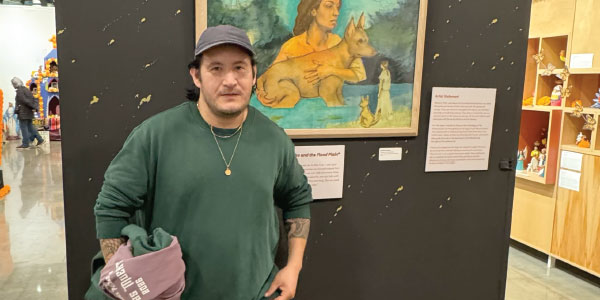
Zapata, who will do a live drawing this Sunday (Nov. 1) at the Nelson-Atkins Museum of Art in Kansas City, Missouri, as part of its Day of the Dead celebration, classifies his work as “magical realism.” His themes are memory, time and the spaces people live in, and how family stories are woven into the places they inhabit, he said.
Whether depicting bags of soda or other images, Zapata has drawn since his childhood. Growing up in a tough neighborhood, drawing gave him something to hold onto, he said.
Later, Zapata’s interest in drawing led him to art school, where he studied animation, he said. He has worked in painting, drawing and animation ever since.
“Whether it be painting, drawing or animation, I’ve just always worked within those fields,” Zapata said.
Zapata’s artistic path is meaningful to him partly because of his background. He’s the son of Mexican immigrants. His father is from Camargo, Chihuahua. His mother’s family is from Gomez Palacio, Durango. Like many immigrant parents, they had little room to chase their own dreams, he said.
When Zapata told his parents he wanted to pursue his dream of creating art, they encouraged him, he said. Zapata also said they understood what his decision meant, because taking a chance is what brought them to this country.
Zapata pursues his dream by practicing his art every day. The daily practice brings him “a lot of happiness and fulfillment,” he said.
But art doesn’t work like other careers, where there are promotions and milestones, Zapata said.
“With art, it’s not that. Art is you,” he said. “What you do is art.”
Zapata keeps a line between his purpose and how he makes a living, he said.
“My purpose is to make art,” Zapata said.
What Zapata does to earn money is a separate matter, he said.
As part of pursuing his purpose, Zapata belongs to Migrating Assembly Stories and Art (MASA), a collective that brings together artists who, in his words, feel like outsiders. Several MASA artists, including Zapata, have work their work on display in an exhibit that’s running through Dec. 4 in the Kansas City, Kansas, Community College Art Gallery. An exhibit reception is scheduled for 5-7:30 p.m. Friday (Oct. 30).
Asked what he would tell young Latinos who want to be artists, Zapata said not to confuse a career with practice. He also said he would tell them that technique comes with time and what matters most is having ideas, effort and a voice.
“It’s not like a sport, where you’re done at 30,” Zapata said.
Art continues into a person’s 70s and 80s, and the work changes along the way, Zapata added. The key is to listen to your heart, he said.
“Your art will tell you where to go,” Zapata said. “As long as you stay true.”
To see more of Zapata’s work, visit his Instagram account at @ez_zapata.
Zapata pinta recuerdos que unen dos culturas
Para Emiliano Zapata, un refresco servido en una bolsa no es una imagen extraña: es un recuerdo.
En varias partes de México es común que el refresco se vacíe en una bolsa de plástico y se entregue con un popote. Para quienes crecieron viéndolo, es algo de todos los días. Para otros, genera dudas.
Zapata, artista radicado en el área metropolitana de Kansas City, pinta momentos como ese, sin explicarlos ni exagerarlos.
“Para mí es algo natural”, dijo. “No tengo que forzarlo”.
Zapata, quien hará un dibujo en vivo este domingo (1 de nov.) en el Nelson-Atkins Museum of Art, en Kansas City, Missouri, como parte de su celebración del Día de Muertos, define su trabajo como “realismo mágico”. Sus temas son la memoria, el tiempo y los espacios donde vive la gente, y cómo las historias de familia se entretejen con los lugares que habitan, explicó.
Ya sea que retrate refrescos en bolsa u otras imágenes, Zapata dibuja desde niño. Como creció en un barrio difícil, el dibujo le dio algo a qué aferrarse, contó.
Más adelante, su interés por el dibujo lo llevó a una escuela de arte, donde estudió animación, indicó. Desde entonces ha trabajado en pintura, dibujo y animación.
“Sea pintura, dibujo o animación, siempre he trabajado en esos campos”, expresó Zapata.
El camino artístico de Zapata tiene un significado especial para él, en parte por su origen. Es hijo de inmigrantes mexicanos: su papá es de Camargo, Chihuahua, y la familia de su mamá es de Gómez Palacio, Durango. Como muchos padres inmigrantes, tuvieron poco margen para perseguir sus propios sueños, dijo.
Cuando Zapata les dijo a sus papás que quería perseguir su sueño de crear arte, lo animaron, contó. También dijo que entendieron lo que implicaba su decisión, porque arriesgarse fue lo que los trajo a este país.
Zapata persigue su sueño practicando su arte todos los días. Esa práctica diaria le da “mucha felicidad y realización”, manifestó.
Pero el arte no funciona como otras carreras, donde hay ascensos y metas que se van cumpliendo, indicó Zapata.
“En el arte no es así. El arte eres tú”, dijo. “Lo que haces es arte”.
Zapata separa su propósito de la manera en que se gana la vida, dijo.
“Mi propósito es hacer arte”, afirmó Zapata.
A lo que se dedica para ganar dinero es otro asunto, agregó.
Para seguir ese propósito, Zapata pertenece a Migrating Assembly Stories and Art (MASA), un colectivo que reúne a artistas que, en sus palabras, se sienten como forasteros. Varios artistas de MASA, entre ellos Zapata, exhiben su obra en una muestra que estará abierta hasta el 4 de dic. en la galería de arte (Art Gallery) del Kansas City, Kansas, Community College. La recepción de la exposición está programada de 5 a 7:30 p.m. el viernes (30 de oct.).
Al preguntarle qué les diría a los jóvenes latinos que quieren ser artistas, Zapata respondió que no confundan una carrera con la práctica. También les diría que la técnica llega con el tiempo y que lo más importante es tener ideas, esfuerzo y una voz propia.
“No es como un deporte, donde a los 30 ya terminaste”, comentó Zapata.
El arte continúa hasta los 70 y 80 años, y la obra va cambiando en el camino, añadió Zapata. La clave es escuchar al corazón, expresó.
“Tu arte te dirá hacia dónde ir”, dijo Zapata. “Mientras te mantengas fiel a lo que eres”.
Para ver más obras de Zapata, visite su cuenta de Instagram @ez_zapata.